Nagaland Police has grown from a single outpost in 1888 into a force of almost 24,000 personnel, with modernisation of infrastructure, mobility, weaponry and communications continuing steadily. Most police stations and outposts, once run from rented premises, are now housed in permanent government buildings.
The newest addition to the force’s structure is the India Reserve (IR) battalion — rapid deployment units trained in counter-insurgency and jungle warfare alongside the Army and Assam Rifles.
An aerial view of one of Nagaland Police's district complexes.
Unit
Year Raised
Headquarters
Motto
9th NAP (IR)
1999
Saijang
The Daring Ninth
10th NAP (IR)
2002
Zadima
The Striking Tenth
11th NAP (IR)
2005
Chumukedima
The Valiant Eleventh
12th NAP (IR)
2006
Tuli
The Gallant Twelfth
District & Unit Structure
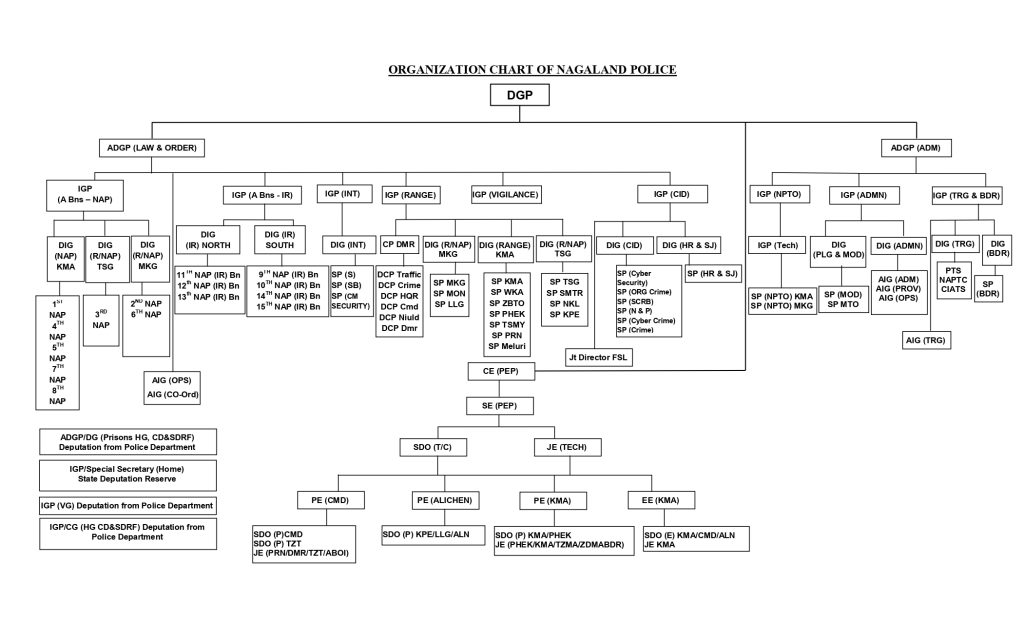
The state is currently served by 54 Police Stations — including four Traffic Control Stations and two Women Cells — plus two units with state-wide jurisdiction and the powers of a police station: the Narcotics Branch and the Crime Branch. Every district — Kohima, Dimapur, Mokokchung, Phek, Wokha, Tuensang, Peren, Mon, Zunheboto, Longleng and Kiphire — has its own Superintendent of Police, supported by Armed Battalions (the 1st through 13th NAP) stationed across the state.
Training the Force
Police Training School (PTS)
Established on 1 November 1966 with Dy.SP Marmendang Ao as its first Principal, PTS delivers basic training to Assistant Sub-Inspectors and recruits of the District Executive Force, along with regular in-service courses for officers and men. It also trains new IPS, NPS and state Civil Service probationers, and Sub-Inspectors.
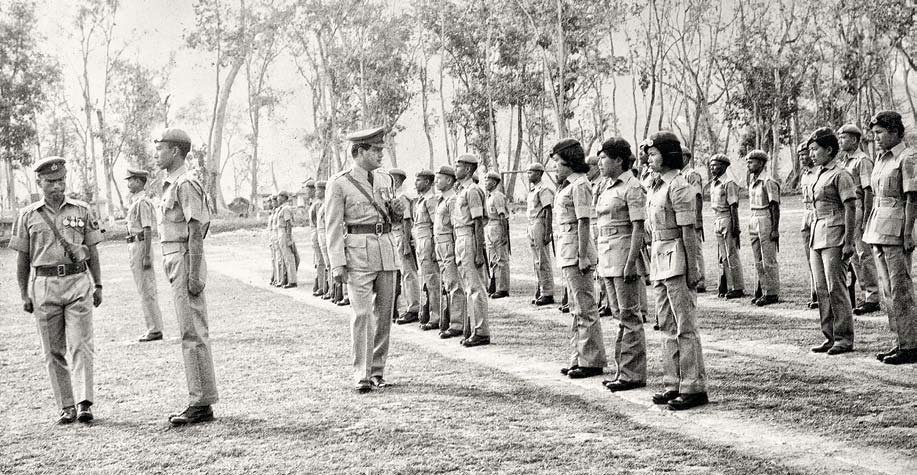
An inspection parade at one of the force's training establishments, including women cadets.
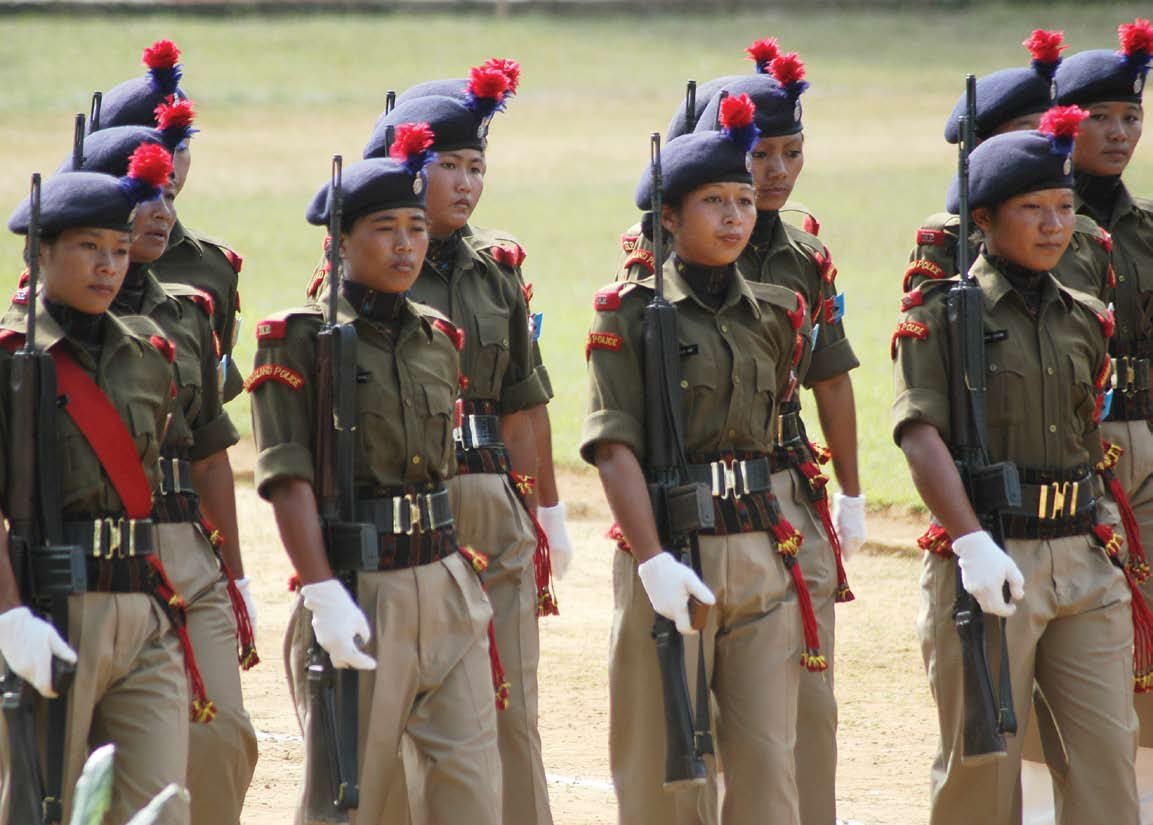
Women personnel of Nagaland Police on parade — women have become an increasingly integral part of the force in recent decades.
Specialised Wings
Intelligence Wing — originally the Special Branch, organised in 1964 with 27 personnel; today a 900-plus-strong wing led by an Inspector General (Intelligence), encompassing the Special Branch, Security Branch and Narcotics Branch.
Crime Branch — separated from the Intelligence establishment in 2000, handling major crime investigation under an Inspector General (Crime).
Forensic Science Laboratory, Dimapur — established 26 February 1982.
Nagaland Police Telecommunication Organisation (NPTO) — formed in 1995 from the merger of the Police Radio Organisation and NAP signal platoons; runs HF, VHF and (since 2004) satellite communication networks.
Nagaland Police Central Hospital — converted from the 1st NAP unit hospital in 2000, with a Trauma Care Centre added in 2007.
Police Engineering Project (PEP) — responsible for the force’s infrastructure development.
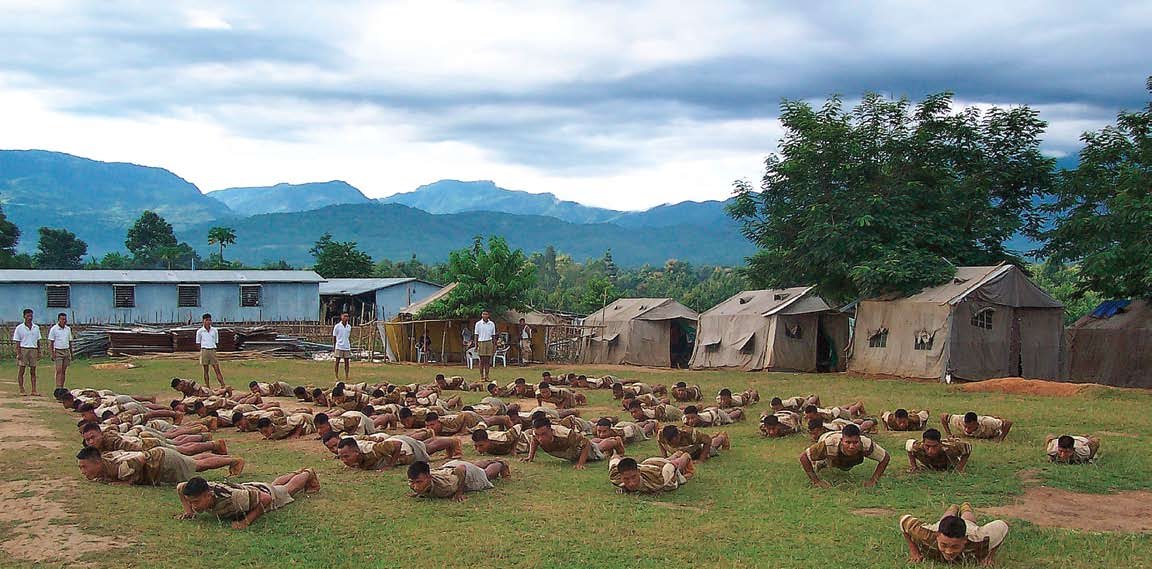
NAP (IR) personnel during physical training — fitness remains a cornerstone of the force's counter-insurgency readiness.