History & Heritage of Nagaland Police
THE FIRST POLICE STATIONS ESTABLISHED IN THE DISTRICTS
Kohima – 1888 (Outpost); 1933 (Police Station)
Dimapur – 1939
Mokokchung – 1951
Phek – 1963
Wokha – 1964
Tuensang – 1966
Peren – 1966
Mon – 1969
Zunheboto – 1972 (In Satakha and Aghunato)
Longleng – 1982
Kiphire – 1982
THE FORMATIVE DECADES AFTER 1963
The Nagaland state police force came into being with the formation of the state on 1st December, 1963. The police officers and men who were earlier posted in the Naga Hills comprised the nucleus around which the new regular state police force was raised. After 1963, police stations were opened in Wokha and Zunheboto in addition to the ones already functioning in Kohima, Dimapur, Mokochung and Tuensang, and gradually more and more police outposts were opened up (See Box).
On 1st March, 1965, Shri K.G. Nanavati, an I.P. officer, was appointed as the first Inspector General of Nagaland Police. Shri L. Lungalang, IFAS also headed Nagaland Police as the Ex-officio Inspector General from February 1966 to July 1967, continuing a precedent from the time when civilian administrative officers– initially the Deputy Commissioner of the Naga Hills and after statehood, the Commissioner of Nagaland- also looked after the police.
When the state administration was reorganised in 1974, Sub-Divisional Police Officers were posted in the districts. The police administration was reorganised in 1982 and following this, Superintendents of Police were posted to all the administrative districts. In 1986, the IPS cadre was introduced in the state. With this, Shri K. K. Zutshi became the first Director General of Nagaland Police in the year 1987.
In the initial years of statehood when the armed insurgency in Nagaland was at its peak, priority was accorded to raising the armed battalions. The first Nagaland Armed Police (NAP)units- the 1st and 2nd battalions, raised respectively in April and August 1964, were originally known as Special Armed Police andit was only in 1966 that they were renamed as Nagaland Armed Police battalions. The 1st NAP battalion initially comprised of a batch of 133 surrendered undergrounds (UGs). Subsequently, the Government decided to amalgamate the Village Guard units of Kohima and Mokokchung into the 1st and 2nd armed battalions. Large numbers of volunteer personnel found physically fit from the Village Defence Guard unit of Kohima were absorbed into the 1st battalion while those found medically unfitwere discharged. Thus a homogeneous unit emerged by combining major elements of the Village Guards, surrendered UGs, Assam Rifles and Assam Police officers and personnel on transfer and deputation, as well fresh recruits. Similarly, the 2nd NAP battalion was raised by converting the Mokokchung district wing of the Village Guards.
Roots in the Naga Hills
Long before a police force in the modern sense ever set foot in the Naga Hills, Naga society already had its own effective system of keeping the peace. Village elders and headmen, known as Gaonburahs, were the traditional custodians of law and order, empowered to arbitrate customary law within their own village jurisdictions. Alongside them, the Dobhashis — local interpreters and intermediaries — helped bridge the gap between village life and, later, the colonial administration, doubling up as local mediators and an early information network.
The first formal contact between the British and the Nagas dates to 1832, when an expedition led by Captain Jenkins and Captain Pemberton surveyed a road route between Assam and Manipur. Naga Hills became a district of Assam in 1866, and it was only in 1888 that the first police outpost was established at Kohima — a modest unit of one Sub-Inspector, two Assistant Sub-Inspectors and 12 constables, all drawn from the District Executive Force of Sibsagar. A second outpost followed at Dimapur in 1890.
It was not until 1933 that Kohima got its first proper police station, on the site of today’s North Police Station, with Sub-Inspector I. Chetia as its first Officer-in-Charge. This station would go on to play a role in one of the most significant chapters of the region’s history: the Battle of Kohima.
The Battle of Kohima (4 April – 22 June 1944)
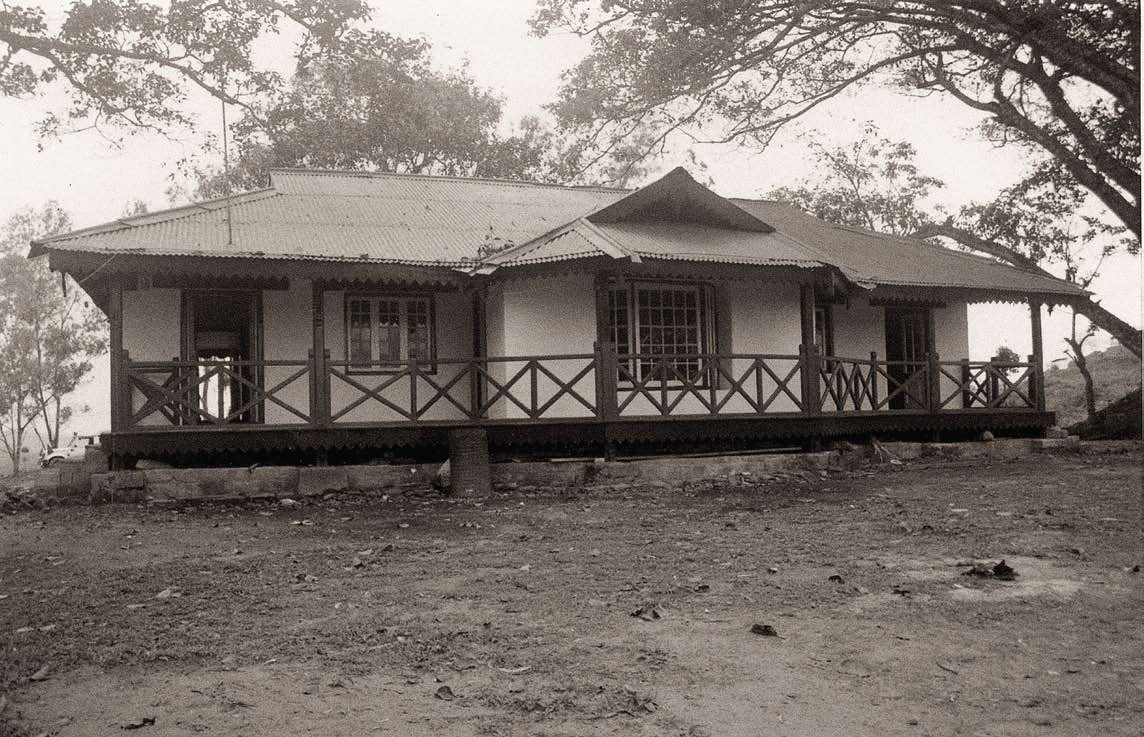
In the spring of 1944, the Japanese Army’s 31st Division advanced into the Naga Hills as part of the larger ‘U-Go’ offensive, cutting off the Kohima-Imphal road and encircling the town. What followed was one of the most fiercely contested battles of the Second World War’s Burma campaign. British and Indian troops, resupplied only by air, held out through a thirteen-day siege, with some of the bitterest fighting taking place around the Deputy Commissioner’s bungalow and tennis court — site of hand-to-hand combat that has since entered military history. The siege was lifted on 18 April when the Kohima-Dimapur road reopened, though clearing operations continued for two more months. By the end, the British and Indian forces had lost around 4,000 men; Japanese losses exceeded 7,000.
From District to Statehood (1947–1963)
Independence in 1947 brought little immediate change to the policing set-up inherited from the British. Police personnel remained under the administrative officers until the Office of the Superintendent of Police, Naga Hills District, was created at Kohima on 28 December 1953, with Shri Kumar Randip Singh, IPS, as the first Superintendent of Police.
The following decade saw rapid political evolution: the Naga Hills Tuensang Area (NHTA) was formed in December 1957, the Naga People’s Convention pressed for statehood, and the Sixteen Point Agreement of 1960 paved the way for a new state within the Indian Union. On 1 December 1963, President Dr S. Radhakrishnan formally inaugurated Nagaland as the 16th state of India — and with it, a dedicated Nagaland Police force came into being, built around the officers and men who had served the Naga Hills administration.
Building the Force
The first police stations were established district by district over the following two decades: Dimapur (1939), Mokokchung (1951), Phek (1963), Wokha (1964), Tuensang and Peren (1966), Mon (1969), Zunheboto (1972), and finally Longleng and Kiphire (1982). Shri K. G. Nanavati, IP, served as the force’s first Inspector General from 1965, followed by a succession of officers who oversaw the force’s growth from a handful of outposts into a modern state police organisation. In 1987, following the introduction of the IPS cadre to the state in 1986, Shri K. K. Zutshi became Nagaland Police’s first Director General of Police.
The insurgency years that shaped much of Nagaland’s early statehood also shaped its police force. The first Nagaland Armed Police (NAP) battalions — the 1st and 2nd — were raised in 1964, built substantially around Village Guard units, surrendered underground cadres, and personnel on transfer from the Assam Rifles and Assam Police. Over the following two decades, battalions 3 through 8 followed, giving the force the armed, mobile capacity it needed for counter-insurgency operations.
Nagaland Police Gets Its Colours (1985)
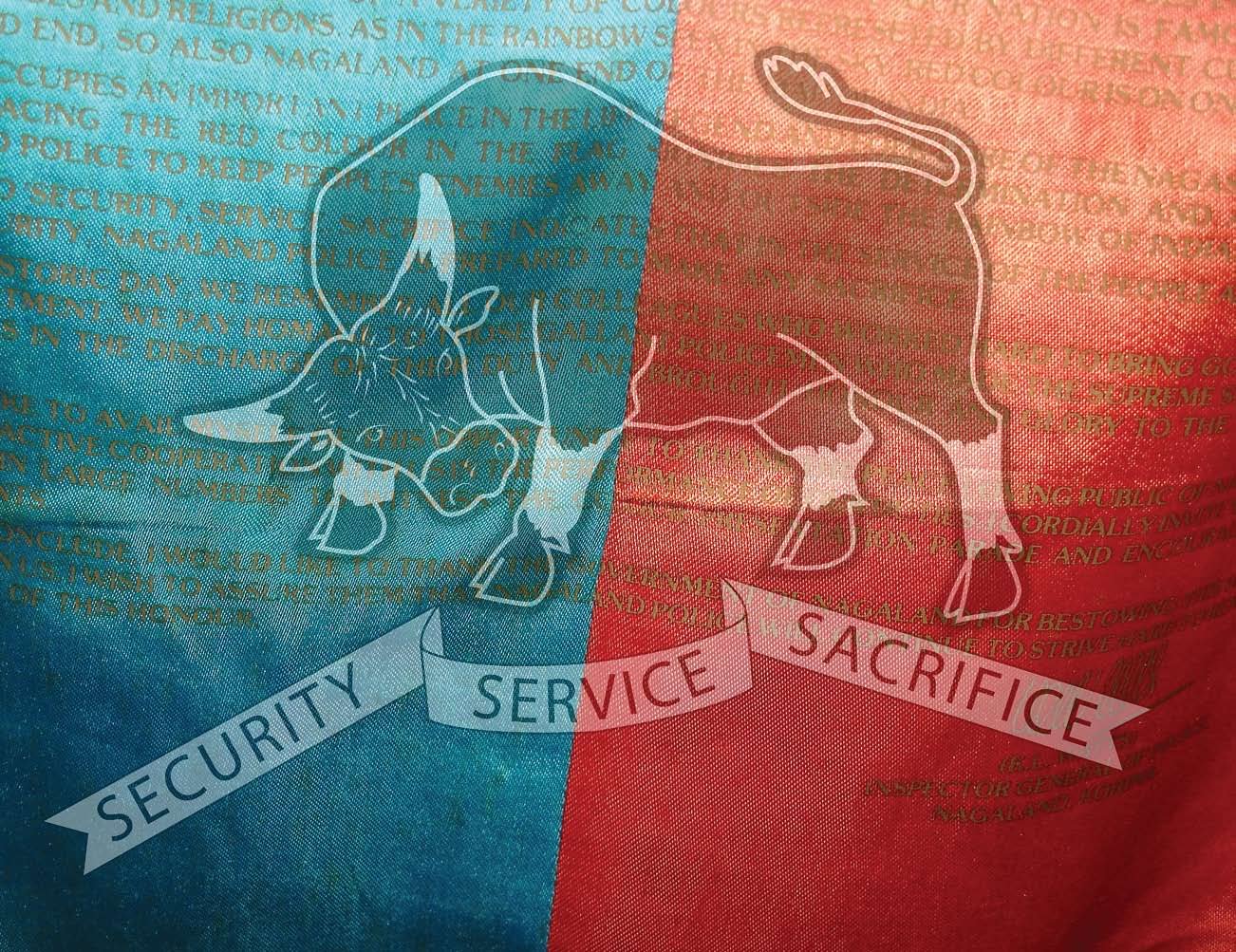
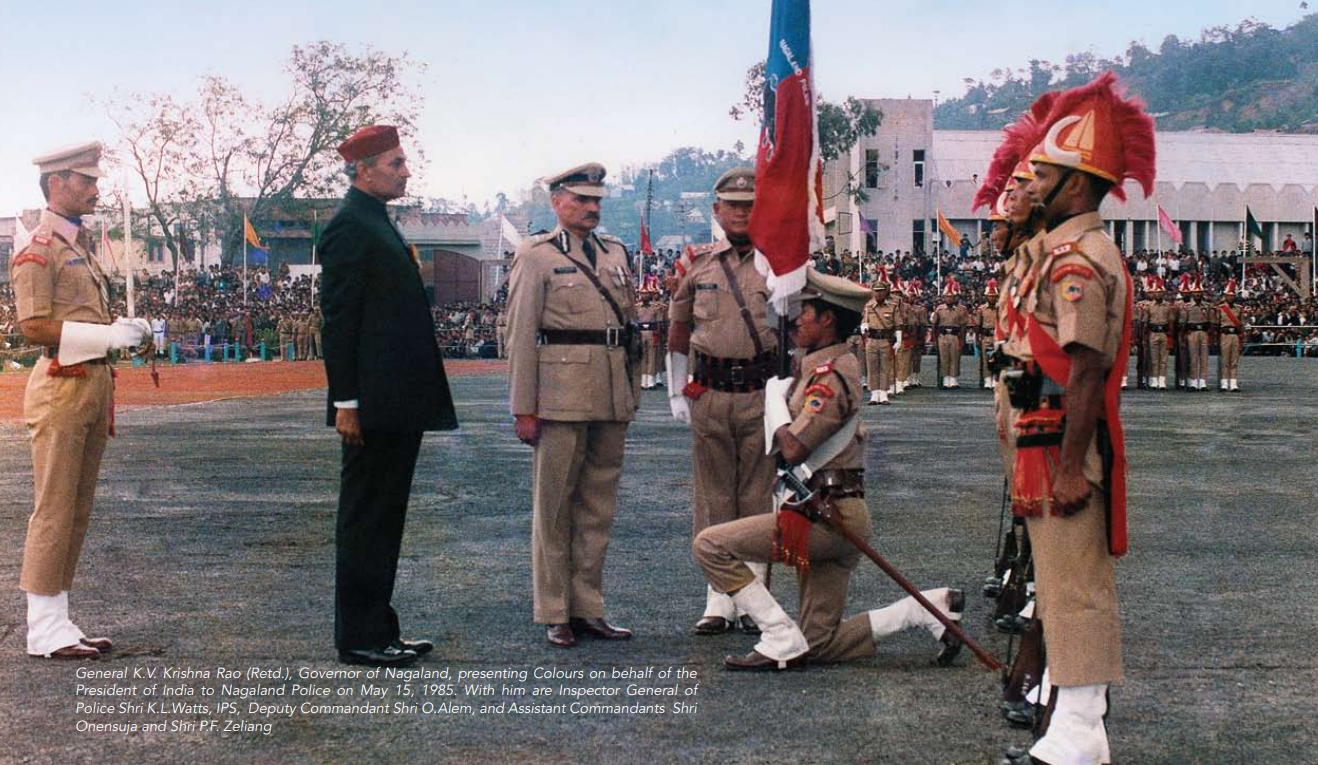
On 15 May 1985 — just 22 years after its formation — Nagaland Police became one of the first state police forces in the country to be presented with its own Colours, an honour traditionally reserved for military units. The initiative was driven by Inspector General Shri K.L. Watts, IPS, who lobbied successfully in Delhi to have the force’s history and achievements in counter-insurgency recognised at the same level as military battle honours. General K.V. Krishna Rao (Retd.), then Governor of Nagaland, presented the Colours on behalf of the President of India.
The design carries real meaning: sky blue and red, with a charging mithun and the motto ‘Security, Service, Sacrifice’ inscribed beneath it. Blue represents the heights the force aspires to and the depth of its resources; red signifies vigour, valour and vitality. The mithun — an animal central to Naga folklore — faces the red field, symbolising the force’s determination to protect the people and keep danger at bay.